Lesle Lewis - John's Table
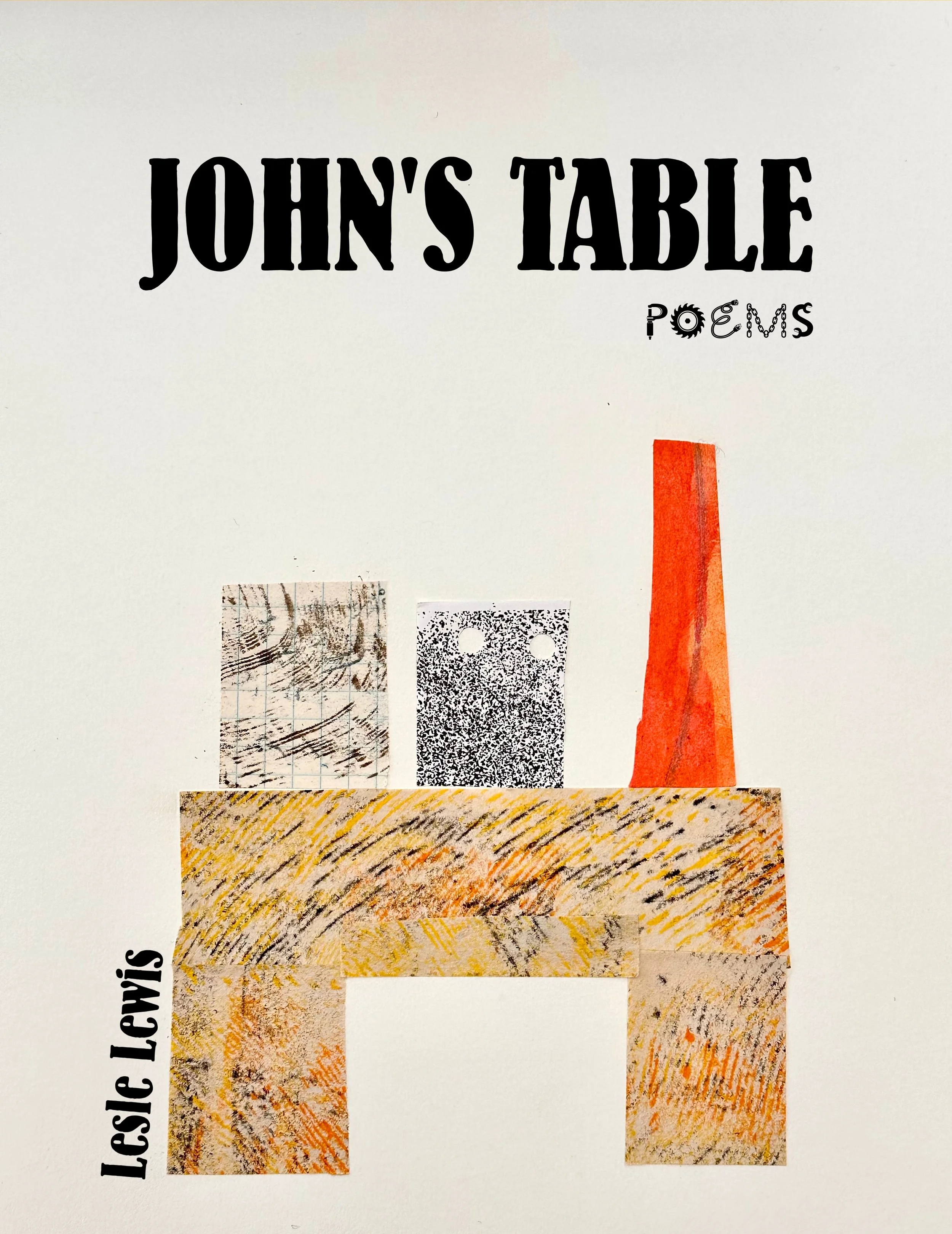
Lesle Lewis - John's Table
The sixth poetry collection from Lesle Lewis. Arranged in 45 monostich pieces, all with single-word titles, this book showcases a poet who, after more than 20 years of releasing books into the world, is an artist continuing to master her craft.
The third release of Piżama Press!
Poems by Lesle Lewis
70 pages
Publication date: May 27, 2026
Cover art by Emily Pettit
About the Author
Lesle Lewis is the author of six full-length collections of poems, including her debut collection, Small Boat, which was the winner of the 2002 Iowa Poetry Prize. She's released two books through Alice James Books, one book with Cleveland State University Poetry Center, and, most recently, Rainy Days on the Farm through Fence Books (2019). She has additionally released two chapbooks through Factory Hollow Press (It’s Rothko in Winter or Belgium in 2012 and Hydrogen in 2025). She also has a seventh full-length poetry collection arriving later in 2026. Her poems have appeared in American Letters and Commentary, Northern New England Review, Hotel Amerika, Mississippi Review, The Cincinnati Review, Green Mountains Review, Barrow Street Mudfish, LIT, Pool, jubilat, notnostrums, Sentence, Bat City, Common Place, and Mercurius. She lives in the rough New Hampshire woods with the rest of the trees.
About the Book
John’s Table is Lewis’ sixth full-length book of prose poems. Arranged in 45 monostich pieces, all with single-word titles, this collection showcases a poet who, after more than 20 years of releasing books into the world, is an artist who continues to master her craft. John's Table spotlight's the New Hampshire-based author's writing in peak form, with her lines moving fluidly between feeling like napkin notes and fragments scribbled upon waking from a dream. This braiding of daily life ("There's a noise in the woodshed. / The unknowable is everywhere.") with magical moments ("She laughs her head off and hands it to me.") results in an intimate snapshot of a poet fully inhabiting her abilities. Shifting between the “I,” the “you,” and the “we,” John's Table feels simultaneously personal and communal, connected to and estranged from the world surrounding the writer. Full of loss and worry yet joy and hope, with an overall unease of our excessive use of technology, the poems tangle big-picture questions with internal confusions, internal reflections with collective uncertainties. Reading John’s Table feels like flipping through a notepad or watching the news cycle next to a typewriter. Laugh-out-loud funny, heartbreaking, tender, cheerful, and poignant all at once.
Advance Praise
“Wildly alive. A carnival of thoughts. Exotic, familiar. A door in the floor in your bedroom that leads to everywhere. Impossible and pleasing.”
- Rachel B. Glaser, author of Hairdo (The Song Cave, 2017)
“In every upright line of John’s Table, Lewis explores the illusion of stasis and permanence, beginnings and endings, and our estrangement from the fleeting moment we’re in. At the same time, she’s sliding the illusions into infinite uncanny arragements. For without illusions, there would be no art. No poems. No this wonderful book to unfurl and breathe in these new connections flowing over you. A few years back, I experienced a lengthy episode of Hyperfamiliarity for Unknown Faces at the grocery store, and it was magical. This book is the closest I’ve gotten to that feeling since.”
- Jennifer L. Knox, author of Crushing It (Copper Canyon, 2020)
"“The train’s left the station, and we’re on it.” This train, John’s Table, makes stops at the zoo, the Empire of Spring, and New Hampshire, just to name a few. I can never be certain what awaits at each destination: “The quiet woodpile?” “Red dragons mat[ing] on the president’s portrait?” Will I encounter “[t]he animal of love” asking, “‘Why do you want to kill me?’” I “walk one sentence at a time” with Lesle Lewis, her sentences sometimes coated with a tender seriousness, “a bit scraped up but they don’t cry.” Sometimes they are “dreams […] passing scenery.” Either way, I am always delighted. “I’m flying down the hill and shouting. // ‘Look! My feet are off the ground!’”
- Nate Logan, author of Wrong Horse (Moria Books, 2024)
“The deceptively simple syntax of Lesle Lewis’s poems belies a captivatingly complex intelligence. The tight little packets of her sentences have uncannily expansive range: they can turn from whimsy to grandeur on a dime. Lewis knows that the situation we find ourselves in is far too serious for sentiment, yet she also knows that once we stop feeling, we’re doomed. ‘There are no revelations,’ she writes, ‘just ongoingness.’ The hard-won wisdom encapsulated in these poems radiates through every line.”
- Donna Stonecipher, author of The Ruins of Nostalgia (Wesleyan University, 2023)
“John’s Table is a delight to inhabit. Lesle Lewis enlivens sentences–hers are refreshingly unsettling, somehow strange and familiar at once. There’s a kind of alchemy in each poem, as Lewis wills and bewilders accumulation and momentum into an off-kilter balance. “Representation collapsed. / Boxes of light. / Photomontages. / Something, we don’t know what it is, we search the storage units for. / The willed acts we call work and the less-willed we call love.” I daresay this is what sentences are for.”
- Danika Stegeman, author of Ablation (11:11 Press, 2023)
Excerpt
a poem from the book, originally appearing in Buffalox8 Journal
Fix
Today is not a morning person.
But “It’s a good day,” says the friendly boy.
Later I get a sad text from you.
Our differences, two triangles.
I go for food and come back.
I march into the building and inquire about employment.
What you don’t want mentioned, I don’t mention.
Well enough we love it being meaningless.
There really is a zero between a positive one and a negative one.
The woman says my poem is stupid.
Hard physical labor might fix it.